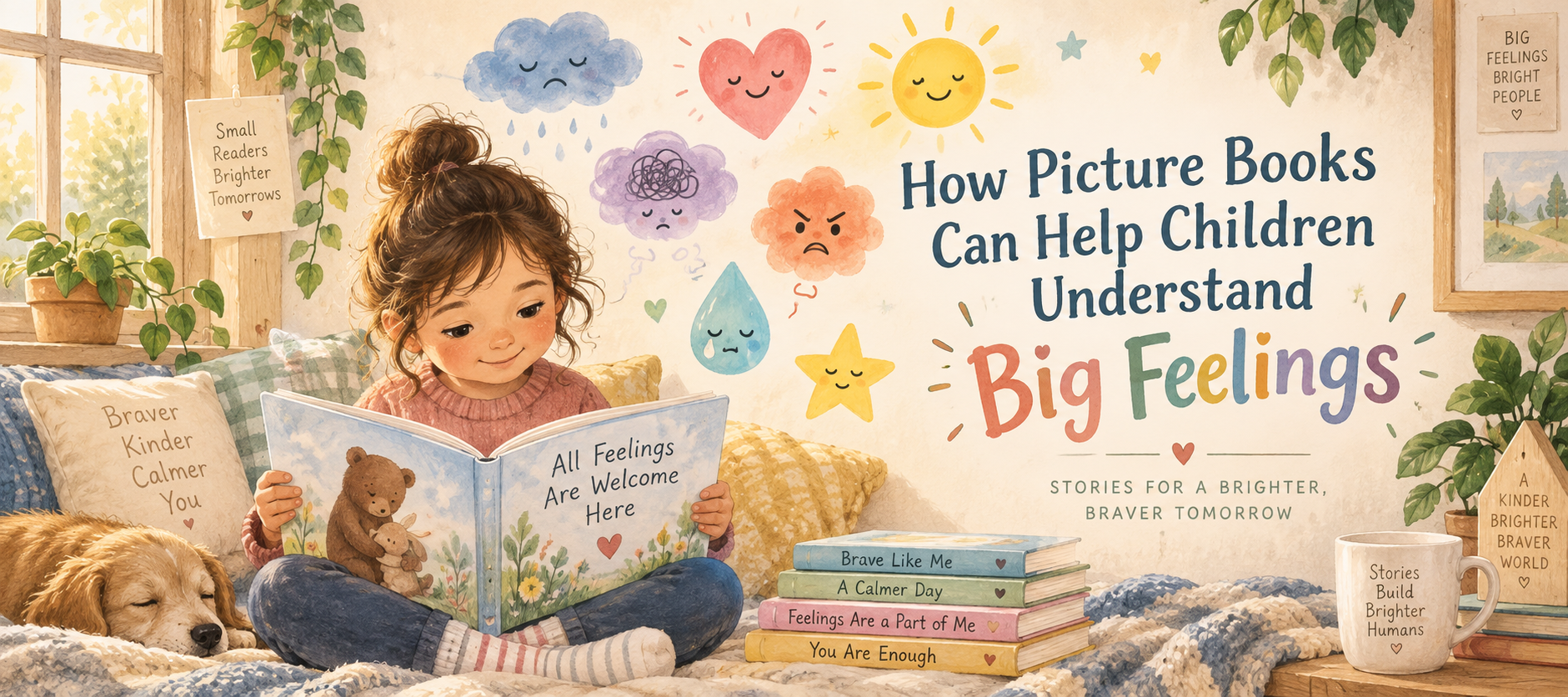
Big feelings can be hard for little people.
A child may know that something feels wrong long before they have the words to explain whether they are angry, embarrassed, worried, disappointed, lonely, jealous, overwhelmed, or simply tired.
Sometimes those emotions come out as tears. Sometimes they look like yelling, hiding, refusing to participate, or becoming unusually quiet.
That is one reason picture books can be such powerful tools for children.
A story gives children a safe place to see emotions from the outside. Instead of being asked to immediately explain what they are feeling, they can first watch a character experience something similar.
And sometimes that little bit of distance makes all the difference.
Stories Give Feelings a Name
Young children are still building their emotional vocabulary.
They may understand words such as happy, sad, and mad, but emotions are usually much more complicated than that.
A child might actually be feeling:
- nervous about trying something new
- disappointed because a friend chose someone else
- embarrassed after making a mistake
- worried that someone they love will leave
- frustrated because something feels too difficult
- left out even though no one intentionally excluded them
Picture books allow children to see those emotions happening inside a story.
A character might clench their hands, hide behind a parent, cry after saying goodbye, or sit alone while everyone else plays.
That creates an opportunity for a grown-up to gently ask:
“How do you think they are feeling?”
The conversation is no longer an interrogation about the child’s behavior. It becomes an observation about the story.
Over time, children begin learning the words they need to describe their own experiences.
Books Show Children That Feelings Are Normal
Children sometimes believe they are the only person who feels a certain way.
They may wonder:
Why am I scared when everyone else seems excited?
Why do I miss someone so much?
Why didn’t I want that hug when everyone else did?
Why am I angry when I know I shouldn’t be?
Seeing a character experience a similar emotion can quietly tell a child:
Other people feel this way too.
That sense of recognition can be incredibly reassuring.
A good picture book doesn’t necessarily make the difficult feeling disappear. Instead, it shows children that uncomfortable emotions are part of being human—and that feelings can be noticed, talked about, and worked through.
Children Can Practice Empathy Through Characters
Picture books do more than help children understand themselves.
They also help children begin understanding other people.
When a character loses something important, feels excluded, makes a mistake, misses someone, or struggles with fear, children get to imagine the experience from another person’s point of view.
You might ask:
“What do you think would help this character right now?”
Children often come up with wonderfully thoughtful answers.
Maybe the character needs a friend to sit beside them.
Maybe they need someone to listen.
Maybe they need space.
Maybe they need reassurance.
Maybe they simply need time.
Those conversations help children recognize that different people may need different things when they are experiencing strong emotions.
That is the beginning of empathy.
Stories Make Difficult Conversations Easier
Some subjects are difficult to introduce directly.
Fear.
Grief.
Separation.
Personal boundaries.
Loneliness.
Bullying.
Missing someone.
Feeling different.
Saying no.
A picture book provides a natural starting point.
Instead of beginning with:
“We need to talk about this.”
A parent or teacher can simply read a story.
The conversation often develops naturally from there.
Children may comment on something a character does or suddenly connect the story to their own lives.
“That happened to me.”
“I feel like that sometimes.”
“I wouldn’t like that either.”
Those small comments can open doors that might otherwise remain closed.
Picture Books Give Children a Safe Way to Explore Choices
Stories also allow children to think through situations before they experience them.
What could the character do next?
Could they ask for help?
Could they walk away?
Could they tell someone how they feel?
Could they try again?
Could they say no?
Could they apologize?
Could they ask a friend if they are okay?
Children are essentially rehearsing emotional and social skills through imagination.
They are learning that feelings do not always have to determine what happens next.
A child can feel angry and still choose not to hurt someone.
They can feel nervous and still ask for help.
They can love someone and still say they do not want a hug.
They can miss someone and still find moments of happiness.
Those are complicated ideas—but stories make them understandable.
The Pictures Matter Too
Children don’t only read the words in a picture book.
They read faces.
Body language.
Colors.
Distance between characters.
A slumped posture may communicate sadness before the text says anything.
A character standing slightly apart from everyone else can show loneliness.
Warm light surrounding a family can create a feeling of safety.
An illustration can sometimes communicate an emotion a child cannot yet name.
That makes picture books especially valuable for younger children who are still developing language skills.
Try pausing before reading the words on a page and asking:
“What do you notice in the picture?”
You may be surprised by how much children see.

You Don’t Have to Turn Every Story Into a Lesson
There is an important balance.
Children should still be allowed to simply enjoy stories.
Not every page needs a question.
Not every character decision needs an explanation.
And not every book needs to become a formal lesson.
Sometimes the most powerful thing a parent, grandparent, caregiver, or teacher can do is read the story, enjoy it together, and allow the child to decide what stays with them.
The lesson may appear days later.
A child might suddenly say:
“Remember when the little bird was scared?”
And then tell you something they have been worried about.
Stories have a way of staying with children until they are ready to use them.
Simple Questions to Ask After Reading
If a story seems to connect with your child, try keeping the conversation gentle.
You might ask:
- Which character did you like the most?
- How do you think that character felt?
- What made them feel that way?
- What would you have done?
- Did anything in the story remind you of something?
- What helped the character?
- What would you say to them if they were your friend?
There doesn’t have to be a correct answer.
The goal isn’t to test comprehension.
It is simply to make space for conversation.
Books Can Give Children Words Before They Need Them
One of the greatest gifts we can give children is language for the experiences they will eventually have.
Words for sadness.
Words for fear.
Words for boundaries.
Words for kindness.
Words for asking for help.
Words for saying, “I don’t like that.”
Words for saying, “I miss you.”
Words for saying, “Can I sit with you?”
Words for saying, “I’m not ready yet.”
A child may not need those words today.
But a story can quietly place them somewhere safe until they do.
That is part of the magic of picture books.
They entertain.
They comfort.
They create imagination.
But sometimes, in the middle of a story about a little bird, a garden, a family, or a child learning to find their voice, they also help children understand something very important:
Big feelings are allowed—and they don’t have to face them alone.
Becky Fry writes children’s stories designed to encourage kindness, curiosity, confidence, and meaningful conversations between children and the grown-ups who love them.